

Designing for Care
How games make us protect what is fragile

Games often make us powerful. They give us weapons, skills, upgrades, maps, systems, and goals. They teach us how to master a world, how to move faster, strike harder, optimize better, survive longer. So much of game design is built around expanding the player’s capacity to act.
But some of the most meaningful games do something quieter. They interrupt that power. They place something fragile in our hands and ask us not to conquer, but to care. A wounded creature that does not always obey. A frightened child watching what we become. A tired horse that needs brushing after a long ride. A spirit waiting for one last meal before saying goodbye. A damaged forest slowly breathing again after the machines are gone.
Care in games rarely begins with a cutscene. It begins with an action repeated often enough to become a relationship: feeding, carrying, waiting, repairing, listening, returning, letting go.
The game does not simply tell us that something matters. It asks us to practice mattering to something else. And that may be one of the most powerful forms of meaningful play.
Because care begins when the player’s power is interrupted by responsibility.

Care is not a feeling first
We often talk about care as if it were an emotion. As if the designer’s task were simply to make players feel attached to a companion, a child, a pet, a community, or a world. Give them a sad backstory, make them cute, put them in danger, add soft music or let the player save them. And sometimes that works, but games have a deeper tool than representation, they have interaction.
In games, care is not only something we feel, it is something we perform: we feed, we heal, we protect, we wait, we carry, we comfort, we clean, we repair and return. And through repetition, the system teaches the body what the story wants the heart to understand.
On paper, these actions can look minor and even inefficient. They do not always advance the plot or create mastery, they might not even reward the player with something spectacular. But they do something else, they create rhythm, and rhythm is one of the ways affection becomes embodied. A single act of care may feel like a task. Repeated care begins to feel like a bond.
Maintenance can become intimacy
Red Dead Redemption 2 understands this beautifully. Arthur’s horse could have been just transportation, but the game slows the relationship down.
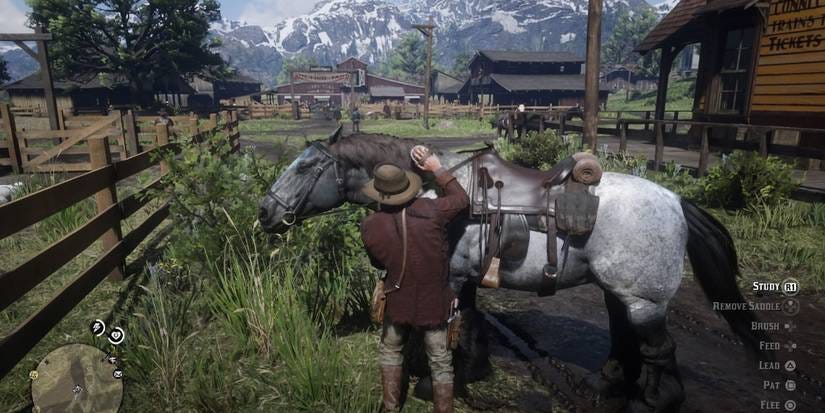
You brush your horse, feed it, calm it, lead it by hand, revive it when it falls, whistle and wait for it to return. Over time, its trust grows and it starts to respond differently. It becomes less like a vehicle and more like a companion with a body, a temperament, and a history of shared travel.
The bond does not come from a single dramatic scene. It comes from use, return, dependency, and maintenance. At first, brushing the horse is just a mechanic, but later it becomes a habit. Then, almost without noticing, it becomes care. This is the strange emotional power of maintenance.
In design, maintenance is often treated as friction: the thing between the player and the “real” experience. But maintenance can become intimate when it stops feeling like upkeep and starts feeling like recognition: the horse is muddy because you rode through a storm, it is tired because you pushed too hard, it needs calming because danger frightened it or it is there because you called.
The system remembers the relationship through the body. This is why care mechanics need more than meters: a meter can measure attachment, but it cannot create it alone. If care becomes only a number to optimize, the relationship collapses back into utility: feed the horse to increase bond level, brush the horse to maintain performance or protect the horse because it is expensive.
That is not quite care yet. Care begins when the player knows the system has a function, but the action starts to exceed that function emotionally: you brush the horse because the horse is dirty, not because the reward is optimal. Because, somehow, it feels wrong not to.
The fragile other
Care needs vulnerability: something must be able to need us. Not necessarily in a helpless way, fragility does not mean weakness, it means exposure. A being, place, or system can be harmed, neglected, misunderstood, exhausted, lost, or changed by what we do.
Without vulnerability, care becomes decorative: the player can admire a character, like them, identify with them, enjoy their dialogue, but responsibility only appears when the relationship has stakes.
This is part of why The Last Guardian is so emotionally unusual.
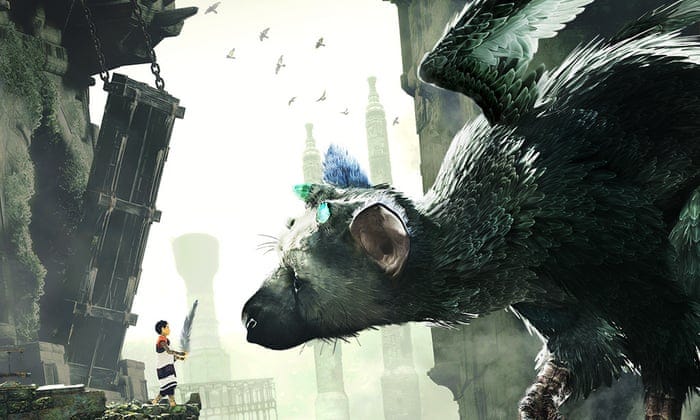
Trico is enormous. Powerful. Sometimes terrifying. This is not a fragile creature in the obvious sense, and yet, emotionally, Trico is one of the most vulnerable companions in games: he is wounded, afraid, distrustful, distracted, hungry, confused, he does not fully understand what the player wants, he does not always obey. And that is exactly why the relationship works.
If Trico responded instantly to every command, he would be a tool. A beautiful tool, maybe, a cinematic tool, but still a tool. Instead, he hesitates, misunderstands, refuses, looks away, gets scared, needs reassurance. You cannot simply operate him, you have to relate to him.
The frustration is not separate from the care, it might be part of it. Because care is easy when the fragile thing is cute, grateful, and efficient. It becomes meaningful when it is inconvenient. That inconvenience creates a subtle emotional shift. The player is still acting, still solving, still progressing, but mastery is no longer enough. You cannot dominate Trico into trust, you have to become patient enough for trust to form: his hesitation is the relationship, his resistance is what separates him from a machine and his vulnerability is what turns command into care.
Care is not control
Jaime Banks and Nicholas Bowman describe player-avatar relationships through dimensions such as intimacy and agency. At one end, the avatar can be experienced as an object: something controlled, instrumental, useful. At another, it can be experienced more like an “other”: a being with perceived agency, separateness, and emotional significance. That distinction matters for care, because care requires a strange balance. The player needs enough agency to respond, but not so much control that the cared-for being becomes an extension of the player’s will.
A perfectly obedient companion rarely feels alive for long. It may be satisfying, useful or support competence, but intimacy often requires separateness. To care for something, I must be able to perceive it as not entirely me.
This also appears in work on character attachment. Lewis, Weber, and Bowman describe attachment to game characters through dimensions such as identification, suspension of disbelief, control, and responsibility for the character’s needs. Later work by Bowman and colleagues suggests an important distinction: enjoyable game experiences are often associated with a strong sense of control, while meaningful game experiences are more associated with responsibility.
Those are not opposites. Games can give us both, but they create different emotional textures:
Control is clean, while care is relational.
Control reduces friction, while care sometimes requires it.
Control asks the world to respond to me, care asks me to respond to the world.
This is why the most emotionally powerful companions are rarely just efficient helpers. They have needs, limits, moods, fears, memories, or forms of resistance. They do not exist only to amplify the player. They interrupt the player’s momentum with their own presence. They make the player adjust.
And adjustment is one of the quiet languages of care.
When protection becomes identity
The Walking Dead does something slightly different with Clementine.
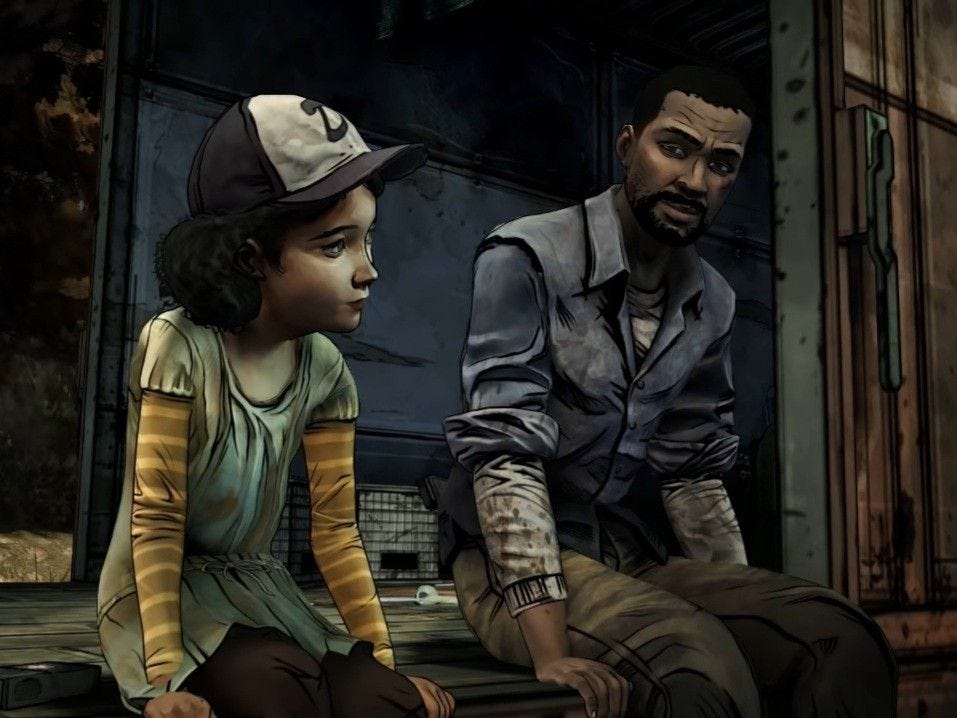
Clementine is not a pet, a mount, or a system. She is a child and a moral presence. At first, protecting her feels obvious. She is young, frightened, and alone in a collapsing world. But over time, the relationship deepens into something more complex. The question is no longer only whether Lee can keep Clementine alive, it is what kind of person he becomes in front of her. The player’s choices are not private. They are observed. That changes the moral atmosphere of play.
Violence is no longer only survival, it becomes example. Mercy is no longer only kindness, it becomes teaching. Lying, stealing, killing, abandoning, forgiving, risking, all of these actions begin to carry a second meaning because Clementine is there. Not because she judges the player through a morality meter, but because her presence makes the player aware of themselves as someone being watched, trusted, and learned from.
Because care is never only about the vulnerable being. It is also about the caretaker. It reveals our patience, our fear, our selfishness, our tenderness, our need for control. It shows us where our values hold and where they begin to bend under pressure.
In that sense, care belongs very naturally beside morality. A moral choice asks what we believe. A care relationship asks what we can sustain.
Care as emotional regulation
Care is often imagined as soft. But in play, care can be difficult, sometimes even uncomfortable, because it asks for emotional regulation, patience, persistence or restraint. The ability to stay responsive when the thing we care for frustrates us, slows us down, or cannot give us the outcome we want.
This is why care is not the same as affection: affection can be immediate, care has duration.
Affection is: I feel something for you.
Care is: I will keep responding to your needs, even when it costs me effort.
Games because games are usually built around efficient action. The player learns to remove obstacles, optimize routes, reduce friction, improve performance, but care often interrupts that logic.
The Last Guardian is about tolerating misunderstanding.
Death Stranding is about carrying weight carefully across difficult terrain.
Spiritfarer is about preparing meals, building rooms, listening to requests, and accompany spirits toward death.
Red Dead Redemption 2 is about slowing down enough to tend to an animal body that has carried us across the world.
These actions can look small, but psychologically they ask a lot. They ask the player not only to act, but to regulate the impulse to rush. That is why care can feel so different from achievement: Achievement often moves toward completion, care moves toward continuity. It is not always about solving, sometimes it is about staying.
Research on emotional intelligence and resilience often connects emotional regulation with persistence: the ability to adapt, endure difficulty, and continue moving toward meaningful goals. In games, care can create a similar emotional demand on a smaller, fictional scale. Not because the game is training us like a workplace intervention, but because the structure is familiar: something matters, something resists, and we have to keep responding.
Care becomes meaningful when it asks more from us than intention, it asks for follow-through.
Carrying as care
Death Stranding makes this almost literal. So much of the game is about carrying: cargo, supplies, bodies, memoriesm,other people’s hopes or a baby in a pod pressed against your chest.
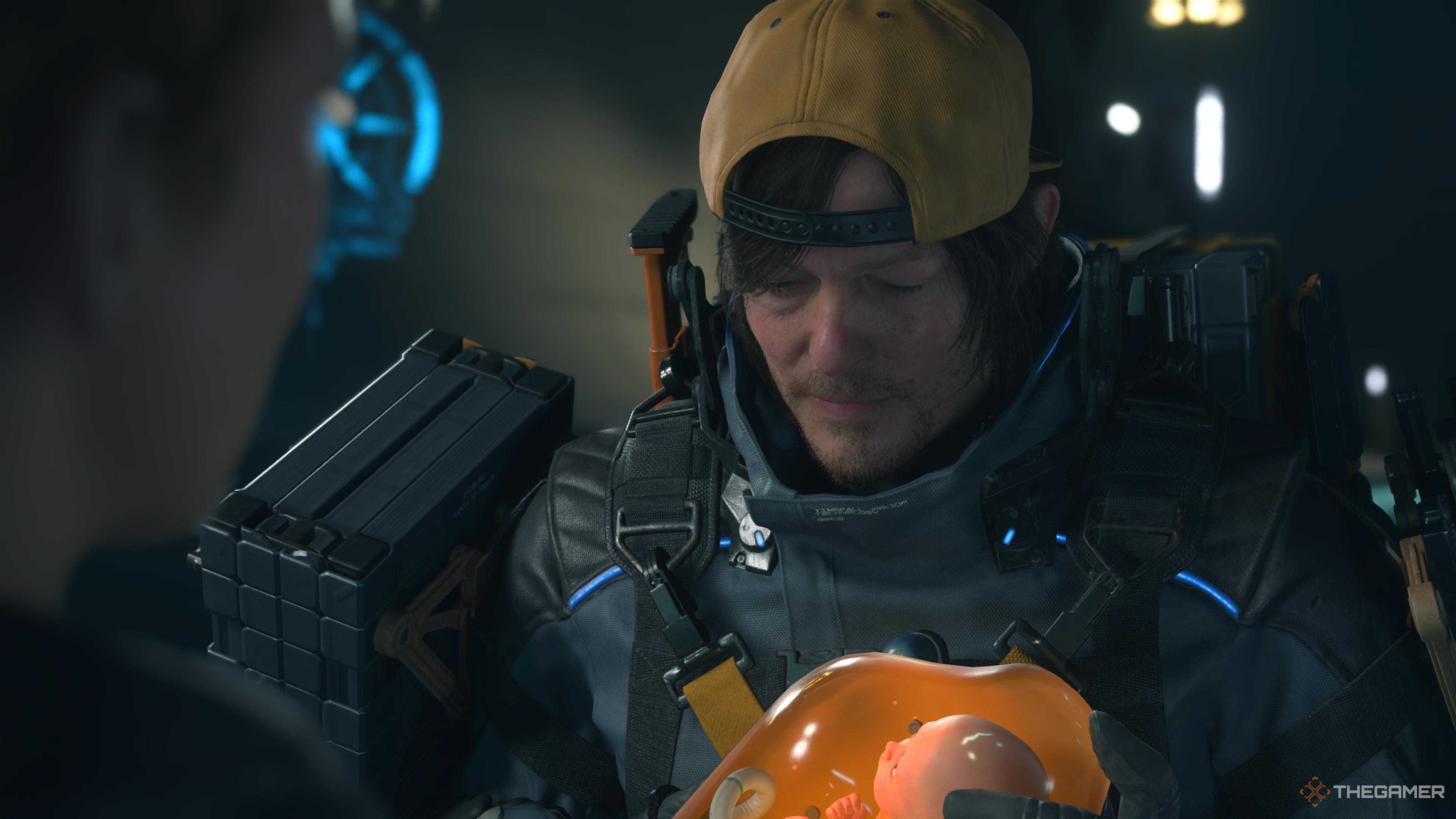
Movement itself becomes an act of responsibility. In many games, traversal is freedom: you run, climb, glide, fast travel. The world is a surface for motion. But in Death Stranding, movement is burdened: you lean under weight, you lose balance, you scan terrain, you place ladders, you soothe BB, you feel the distance because the distance pushes back. The game makes care physical.
To carry something is to become aware of its fragility. You cannot move as if only your own body matters. Every slope, river, rock, and fall becomes relational because something entrusted to you can be damaged. That is a powerful design shift. The player’s body is no longer just a vehicle for agency, it becomes a medium of protection. And when other players’ structures appear in the world: a bridge, a ladder, a rope, a generator; care expands beyond direct companionship. You feel the trace of someone else’s effort. Someone made passage easier. Someone reduced your burden. Someone you may never meet helped you continue. Care becomes infrastructural, not heroic, just a world made more livable by small acts left behind.
That kind of care is easy to underestimate because it does not always look dramatic. But emotionally, it matters. It turns connection into logistics. It makes generosity spatial. The world becomes a place where other people’s care has shape.
Empathy is not enough
It is tempting to say that care begins with empathy and sometimes it does. Empathy allows us to feel with another being, or at least understand something of their internal state. It lets a character’s fear, sadness, pain, or need become emotionally legible. But empathy and care are not the same.
Empathy is a response. Care is a commitment enacted over time.
Empathy: I understand what you feel.
Compassion: I am moved by your suffering.
Care: I will do something about it, and not just once.
Research on empathy and violent games suggests that empathic framing can change how players interpret characters and actions, but the effects depend heavily on context: who the player controls, whether violence feels justified, and whether the player sees a character as victim, villain, or agent.
Empathy can soften aggression, but it can also intensify anger when it frames revenge as deserved. Feeling with someone does not automatically lead to care. Sometimes it leads to punishment. Sometimes to justification. Sometimes to moral certainty.
So the designer’s question cannot simply be: “How do we make the player empathize?” It has to be: “What kind of action does this feeling invite?”
That is where care becomes design. A game can make us feel someone’s pain and still give us only violence as a response. It can make us understand a character’s suffering and then reward domination. It can ask us to protect someone while mechanically treating them as cargo, currency, or leverage.
Care requires alignment between feeling and action. If the game wants tenderness, it must give tenderness a form. If it wants responsibility, it must let responsibility be practiced. If it wants the player to protect what is fragile, fragility must be more than a narrative label, it must be something the system allows the player to notice, respond to, and live with.
The care loop
Care in games often follows a quiet loop.
First, the player notices vulnerability: a creature limps, a child looks afraid, a horse breathes heavily, a forest turns grey, a package begins to break, a companion falls silent.
Then the player responds: they heal, feed, carry, comfort, clean, protect, repair, wait, or return.
Then the world answers: trust grows, the creature relaxes, the child remembers, the horse leans into the touch, the biome recovers, the cargo arrives intact, the relationship changes.
Then the action repeats.
And through repetition, task becomes ritual. Ritual becomes attachment. Attachment becomes responsibility. Responsibility becomes reflection.
This is the care loop: Notice > Respond > Receive > Repeat > Attach > Reflect
Not every game needs all of these stages. But when they align, care becomes more than a quest objective, it becomes a relationship between attention and consequence. The important part is not simply that the player performs a caring action. It is that the action returns with enough variation, feedback, and emotional context to gather meaning. A single “press X to comfort” prompt can work in the right moment, but a relationship cannot be built entirely from isolated prompts. It needs return. Because care is cumulative. It grows through the memory of having shown up before.
Care beyond companions
Care does not only belong to characters. Games can make us care for places as well. This is where ecological care becomes especially interesting.
Many games treat nature as inventory: trees become wood, animals become materials, plants become ingredients, land becomes traversal space, the world exists to be extracted, optimized, upgraded, consumed. There is nothing inherently wrong with resource systems. They can be satisfying, elegant, and meaningful. But they also teach a particular relationship to the world: the environment matters because of what it provides.
Care asks for another relationship. The world matters because it can be harmed and because it can respond.
In Avatar: Frontiers of Pandora one of the most meaningful possibilities in that world is the shift from extraction to restoration. RDA sites scar the landscape. Pollution does not exist only as a mission blocker; it appears as injury. And when those places are liberated, the surrounding biome can recover.
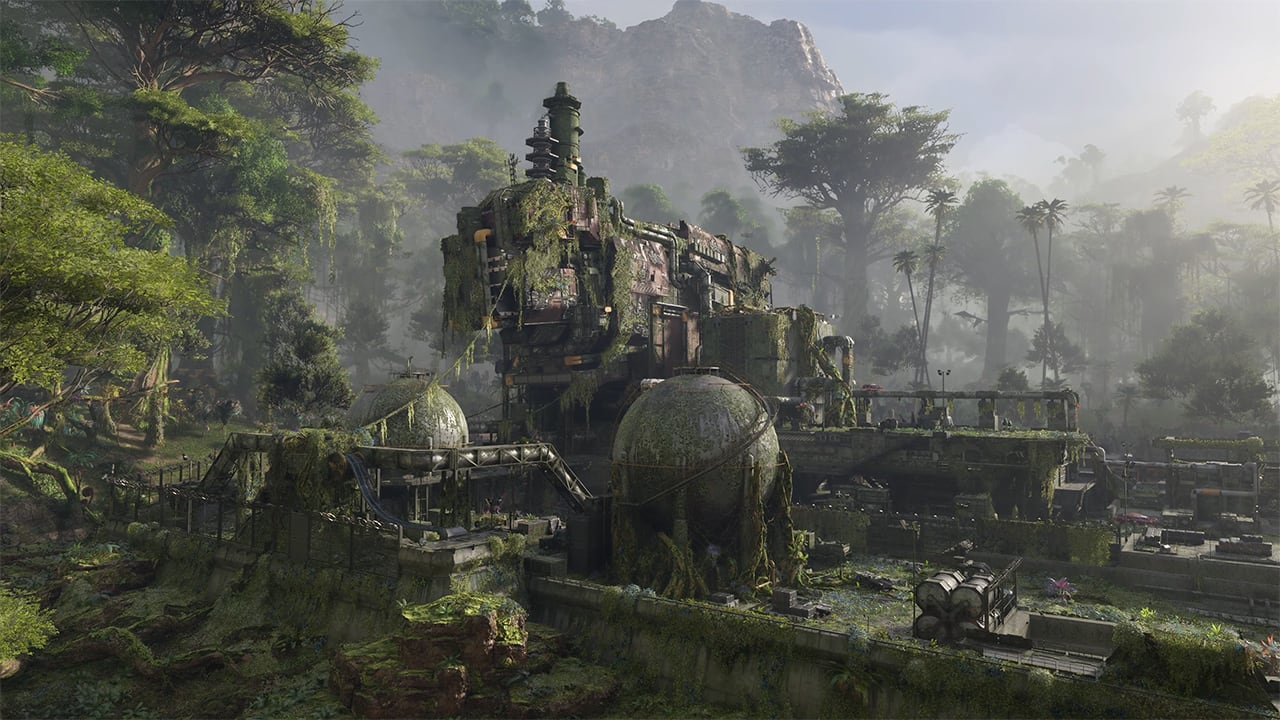
That recovery matters because it makes care visible. A damaged ecosystem slowly returning to life is more than environmental feedback, it is a form of answer. The world is not just rewarding the player, it is breathing again. That changes the emotional meaning of action. Destruction is no longer only combat success. Restoration is no longer only completion. The land itself becomes a vulnerable presence, something capable of being wounded and, with effort, partially healed.
Ecological care begins when the world stops being a container for resources and starts behaving like a living body. A polluted area is not just an obstacle, it is an injury. A recovering forest is not just visual progression, it is reciprocity. And reciprocity is central to resonance. We feel touched by the world, act upon it, and then sense that the world has answered back.
That answer is what makes care feel alive.
When care means letting go
But care is not always restoration. Sometimes care cannot save. Sometimes it can only accompany.
Spiritfarer understands this with painful clarity. On the surface, so much of the game is gentle: you build rooms, cook meals, gather materials, hug spirits, learn their preferences, fulfill requests, make things warmer, softer, more comfortable.
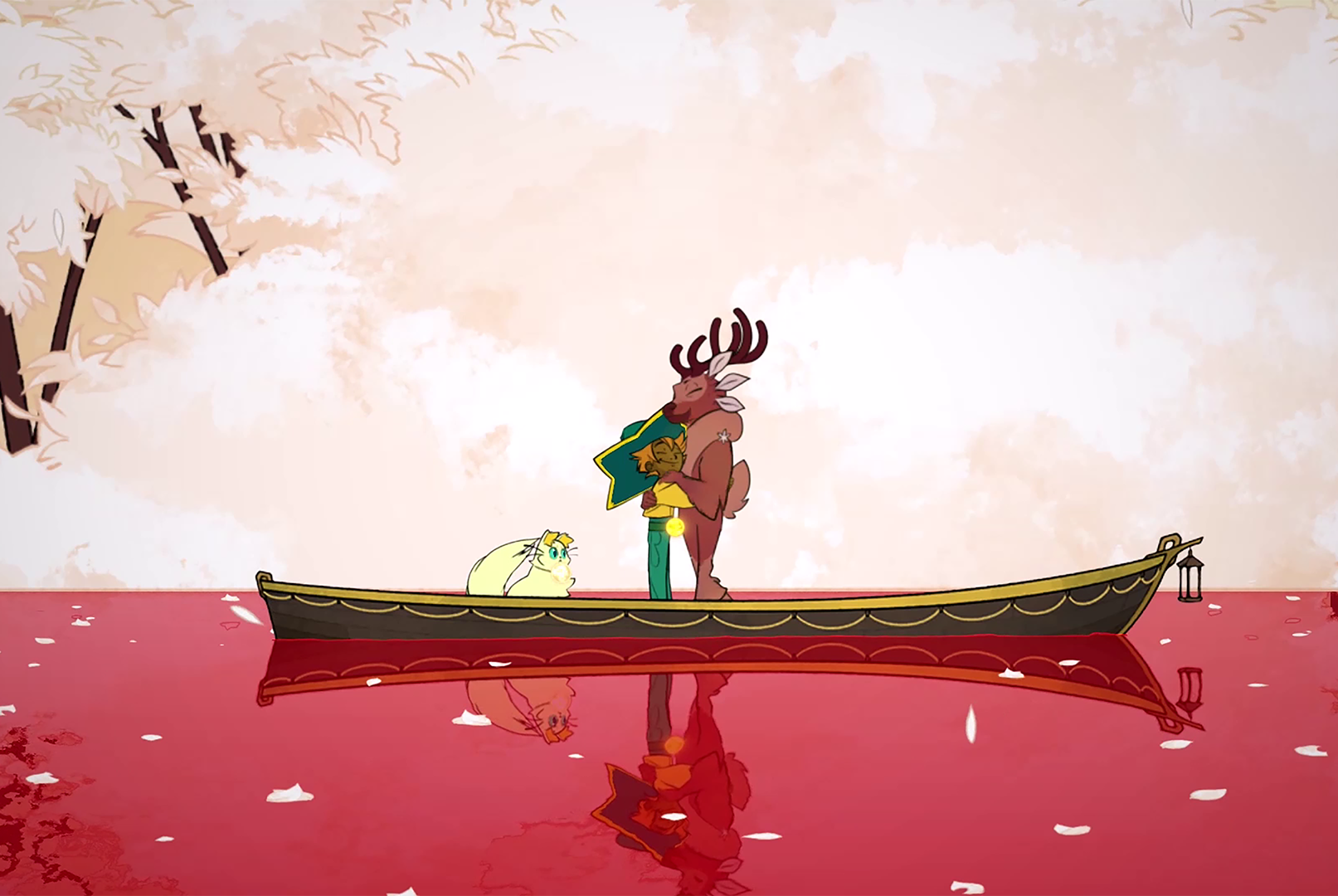
The structure is full of care rituals, but the purpose of care is not to keep everyone with you, it is to help them leave. That is what makes the game so quietly devastating. It takes mechanics that could have been cozy and gives them an existential direction. The meal matters because it may be one of the last. The room matters because it gives someone a place to be themselves before they go. The hug matters because care does not prevent loss, but it can change how loss is held.
This is a more mature form of care than protection.
Protection: I will stop harm from reaching you.
Restoration: I will help you heal.
Accompaniment: I will stay with you through what cannot be fixed.
Games often struggle with this because they are so deeply built around agency. They want to give the player problems to solve, systems to master, endings to unlock, but some experiences become meaningful precisely because they resist solution.
Death cannot be optimized away. Grief cannot be completed. A goodbye cannot be won. Spiritfarer does not remove agency. It redirects it. You cannot save the spirits from leaving. The game understands something many systems avoid: care is not proven by keeping someone with us forever. Sometimes care is proven by helping them leave. That is eudaimonic design at its strongest. Not fun in the simple sense. Not pleasure as ease. But meaning through tenderness, responsibility, and acceptance.
The danger of instrumental care
There is a design risk here. Care systems can easily become optimization systems wearing emotional clothing. Feed the companion to increase loyalty. Give gifts to unlock romance. Pet the animal to gain a bonus. Restore the biome to clear the map. Keep the child safe to get the good ending.
Again, rewards are not the problem, the problem begins when care is reduced entirely to exchange. When the player no longer asks, “What does this being need?” but only, “What do I get?” At that point, care becomes management. Sometimes that is appropriate. Many games are about management. But if the emotional goal is genuine attachment, the system has to leave room for care that exceeds utility.
One way to do this is through asymmetry. The cared-for being should not always repay the player efficiently. The horse may simply calm down. The child may simply trust you. The spirit may tell a story. The ecosystem may become beautiful again. The companion may lean into your hand.
These are not useless rewards, they are relational rewards. They matter because they acknowledge the act without fully converting it into currency.
Care needs feedback, but not all feedback should become profit. Sometimes the reward is not power. Sometimes it is relief, warmth or trust.
The sense that something fragile is a little less alone because you were there.
Designing conditions for care
If care is not just a feeling but a practice, then designing for care means designing the conditions under which responsibility can become emotionally meaningful. Not every game needs this, not every companion should be fragile, and not every world should ask for tenderness, but when care is part of the intended experience, several principles matter.
First, vulnerability has to be legible. Players need to perceive need, not only through UI, but through animation, sound, behavior, pacing, environment, and consequence. A number going down can communicate urgency, but a creature flinching, a child withdrawing, a horse stumbling, or a forest losing color can communicate meaning.
Second, care needs action. Feeling bad for a character is not yet care. The player needs a way to respond. The action can be small, but it should be concrete: feed, hold, repair, carry, wait, choose words carefully, make space. Return later.
Third, the cared-for being needs some otherness. If it behaves only as an extension of the player, it becomes equipment. Care grows when the player senses another rhythm, another need, another presence that cannot be fully absorbed into their own agency.
Fourth, care needs time. Instant attachment is possible, but sustained care usually grows through repetition. The player has to come back. Notice changes. Build familiarity. Remember previous actions. Feel the relationship accumulate.
Fifth, care should change something. Not always dramatically. Not always permanently, but enough for the player to feel that their attention mattered. Trust grows. A room becomes inhabited. A landscape recovers. A companion behaves differently. A goodbye becomes possible.
And finally, care should not be too clean. Real care includes frustration, uncertainty, compromise, and loss. A care system that is only pleasant may become shallow. Meaning often appears when the player must regulate impatience, accept limits, or continue caring without perfect control. That does not mean designers should make care annoying. It means care should be allowed to have weight.
Why care matters
Care is one of the most human forms of play because it changes the direction of attention.
Instead of asking the player to dominate a system, it asks them to notice dependence.
Instead of rewarding only speed, strength, or efficiency, it can reward patience, gentleness, consistency, and presence.
Instead of making the world feel like something to consume, it can make the world feel like something that responds.
This is why care connects so deeply to meaningful gameplay.
It supports relatedness because the player feels connected to another being or world.
It supports morality because the player experiences responsibility.
It supports identity rehearsal because the player discovers what kind of caretaker they become under pressure.
It supports reflection because care lingers. We remember the beings we protected, the ones we failed, the ones we had to release.
And it supports eudaimonia because care is not always pleasurable in the simple sense. Sometimes it is slow. Sometimes it hurts. Sometimes it asks us to stay present with vulnerability we cannot fix. But it feels meaningful because it touches something real.
To care is to let something matter enough to interrupt us. That interruption is powerful. A game creates care when it gives the player enough agency to help, but enough vulnerability to make helping matter. But because somewhere through the repetition of small gestures, the player begins to feel responsible. And responsibility, when freely chosen, is one of the deepest forms of connection games can create.
Meaningful care in games is not about making players love what is useful, it is about letting them protect what is fragile.